
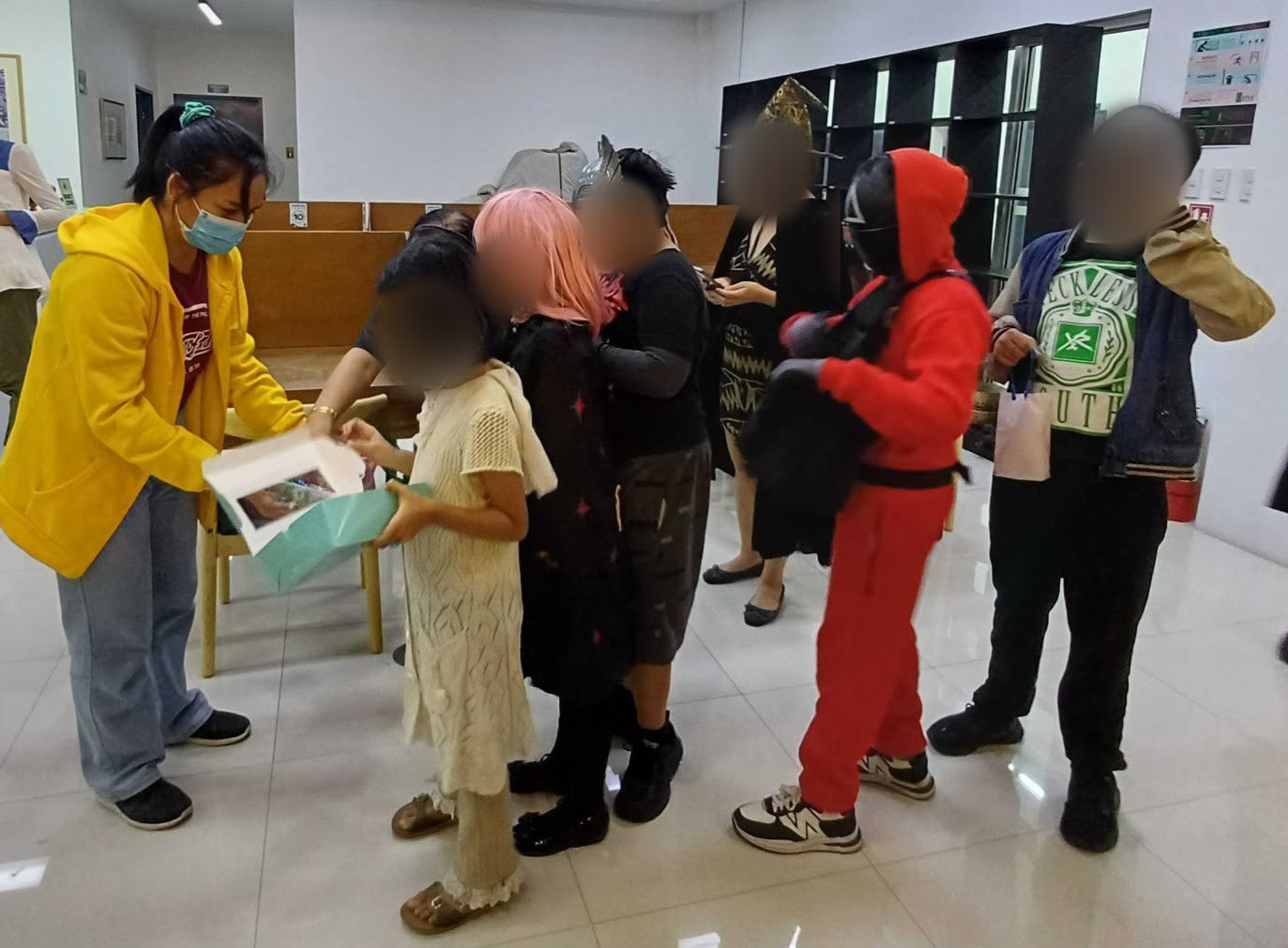
In Western societies, specifically within Europe and North America, the Christian triduum of remembering the dead called “Allhallowtide” commences with Halloween on the night of October 31st (Nangia 2026). Believed to have originated from the Samhain Festival of ancient Celts, Halloween has since evolved and fused with different (religious and non-religious) superstitions that historically defined its current practices such as wearing scary costumes, making jack-o’-lanterns (pumpkin carvings), and trick-or-treating. Despite the variety of traditions, all of these posit one congruence: departed spirits.
In the Philippines, anthropologists indicated that belief in ancestral spirits and the afterlife based on surviving artifacts and rituals have been existent since the pre-colonial period. However, due to colonization, this indigenous spiritual landscape was influenced upon the introduction of (Christian) religious canons. This consequently led to the development of new practices that, when examined closely, show distinct parallelism between these “distant” cultures (foreign and native). One particular example of this is the Pangangaluluwa.
Also called Palimos, the Pangangaluluwa is a music tradition observed amongst the Tagalog ethnolinguistic groups of the Philippines. It is done on the night of Todos los Santos (All Saints’ Day) or Araw ng mga Patay (Day of the Dead), falling on the first of November (Yraola 1977, 53) along with the practices of preparing the “hain” (food offering placed on household altars) and candle-lighting by the threshold of the home (to guide familiar spirits). The Pangangaluluwa mainly features a group of singers referred to as mangangaluluwa or kaluluwa, caroling at houses and begging for alms, either in the form of money or rice (Yraola 1977, 53; Mirano 2017, 39). According to Yraola (1977, 53), it occurs in five stages:
- Kaluluwa singers place] themselves in front of a house;
- A small bell called kampanilya is rung to gain the house owner’s attention;
- A greeting segment noted as magandang gabi (good evening) is performed;
- The pa-Hesus (Jesus), an introductory prayer to St. Gregory, is read; and
- A performance of what is referred to as the “song of the soul” takes place.
To expound, the song of the soul exhibits a thematic progression per stanza: (1) pleading to the house owner, (2) reiteration of ideal conduct towards the mangangaluluwa, as well as the topic the song; (3) narration of various topics such as the miracles of saints and the experience of local townsfolk; and (4) begging for alms and showing of gratitude afterwards (53–55). In terms of genre, pangangaluluwa repertoires are based on popular Spanish or Mexican tunes like the villancico, danza, habanera, and balse, which show no direct relation to the music of the Catholic Church (Mirano 2017, 39).
The audio track below is one of Filipina scholar Elena Mirano’s field recordings archived at the UP Center for Ethnomusicology. According to her tape notes, it was taken during the Feast of St. Matthew on September 21, 1986 in San Mateo, Rizal and not on Todos los Santos, thus making it an elicited rendering. In alignment with Yraola and Mirano’s notes on the Pangangaluluwa, this particular piece is set in waltz (or valse) rhythm (3/4) and has seven stanzas in the form A B A C A D1 D2. The music’s tonality alternates between E♭ Major and minor, except for sections D1 and D2, which are both in the major key signature. An acoustic guitar is used as accompaniment to the two voices that sing the melody (female singer) and harmony (male). The theme of the text is primarily patterned to Yraola’s account The first verse details the calling of house owners: “Patuluyang pumasok / Sa tapat ng durungawan” (Allow us to enter / In front of the window). This is then followed by a statement of the song’s context: “Ito po’y batid niyo na / Piyesta ng mga kaluluwa / Minsan sa isang taon / Tayo ay nagsisipagsaya” (You already know about this / The feast of souls / One night a year / We celebrate).
Afterwards, stanzas four to six tells much about the Tagalog way of honoring the dead. The song also includes narrations of local practices such as attending the eucharistic celebration early in the morning and spending most, if not the rest, of the evening (“nilalamay”) at the cemetery. In lieu of asking for a bounty, the seventh stanza tells of how the kaluluwa singers wish to make the house owners feel through their performance. “Ligayang ganap ang inyong / Ngayo’y napapakinggan / Sa awit nitong masayang samahan” (It is pure joy / That you have experienced / From the song of this wonderful group). The song concludes with a reminder that the group shall return to delight them once again in the following year, if they are still alive (“kung may buhay” pa).
Looking back, there are discernible points of intersection between Halloween and the Pangangaluluwa. The most conspicuous would be the notion of wandering spirits. Amongst the Christianized Tagalogs, these roving souls are represented by the mangangaluluwa (Mirano 2017, 39). In the West, in contrast, jack-o’-lanterns are lit to guide lost spirits, while costumes—originally animal skins—were worn to disguise oneself from souls roaming around during Hallow’s eve (Nangia 2026). Trick-or-treating, on the other hand, also posits similarities with the general idea of the Pangangaluluwa. According to Nangia (2026), Scottish accounts detail that the tradition derives from All Saints’ Day, when “children and poor adults would collect food and money from local homes in return for prayers for the dead.” This process of alms giving in exchange for honoring departed souls directly coincides with the Pangangaluluwa. In fact, still in resemblance to trick-or-treating, Mirano (2017, 39) notes that a mangangaluluwa also plays pranks on “stingy house owners.” Nevertheless, these parallels with the Halloween tradition of the West do not automatically disregard the indigenous attributes of the Pangangaluluwa. The text of the featured piece makes it clear that this Tagalog practice of celebrating the dead is a syncretic tradition, representing both indigenous and (Catholic) Christian spirituality. This was exhibited through elements like “bathala” (supreme deity amongst indigenous Tagalogs) and the Catholic rite of mass.
How can we make sense of these intersections? What do these parallels say about relationalities that characterize music-cultural identity?
In Unsettling Discourses: The Theory and Practice of Indigenous Studies, Martinez and Pamintuan-Riva (2014, 414) propose to “reject the traditionally-accepted binary positions and explore a middle ground” in studying indigenous cultures. The authors in essence express a notion of underlying themes commonly-shared between groups that, when examined, allow interaction rather than separation of different cultures. Juxtaposing the distinct traditions of Halloween and Pangangaluluwa blurred the strict opposition between Western and (Filipino) indigenous cultures; it specifically brought out the intersecting concepts of (1) belief in spirits of the dead, particularly ancestors, and (2) spiritual services reciprocated with money or food as endowment.
However, the whole argument of being limited to commonalities also overlooks socio-political nuances. It was mentioned earlier that colonization—primarily by Spain—significantly influenced the spiritual beliefs of many indigenous communities in the archipelago. In the Pangangaluluwa, Catholic and Hispanic music elements are highly evident; nevertheless, a closer analysis has also shown traces of indigenous (Tagalog) concepts. Musicologist Ma. Alexandra Chua defines this phenomenon using Fernando Ortiz’s “transculturation” as “an active creativity that reshapes both the local as well as the foreign culture, permitting the creation of new and original aesthetic values” (National Music Competitions for Young Artists 2020). Chua then adds its implication as a form of resistance from a community’s encounter with foreign culture. This is what Indian scholar Homi Bhabha (b. 1949) points out as the challenge that colonizers receive from the colonized (Wallach and Clinton 2019, 122). Through their (colonized) agency to express their perspectives and desires, hybrid cultures are formed, which Bhabha claims to have developed within a “third space.” Looking back, despite the Pangangaluluwa’s parallels with Halloween and influences from Spain and Catholicism, it has become its own practice configured by Filipinos that creatively idealize and actualize it through music.
Upon further reflection, it is important to ask whether labels like “Western” and “indigenous” should be dichotomized as Martinez and Pamintuan-Riva imply. Could there really be a universal realm where all these ideas and concepts are shared by all, and our role as humans is simply to creatively express these abstractions? Yet, Bhabha’s notion of a zone intended for the amalgamation of different cultures is an apt response to the dismissal of binary positions. Nevertheless, the perception of these fused traditions as something “new” remains questionable. How can we assure that a colonizer’s culture can easily be owned by the colonized? In an endless cycle of enculturation, perhaps the best option is to focus on maintaining and enriching our milieu through the arts instead of enforcing strict categories while understanding what is “gained” and “lost” in the process, and the consequences of change.
References
- Martinez, Darius Letigio, and Ma. Paula Luz Pamintuan-Riva, eds. 2014. Unsettling Discourses: The Theory and Practice of Indigenous Studies. Philippines: Cordillera Studies Center and Tebtebba Foundation.
- Mirano, Elena Rivera. “Hispanic Traditions and Transformations in Philippine Music (1565 Onward).” In Cultural Center of the Philippines Encyclopedia of Philippine Art, Second Edition. Cultural Center of the Philippines, 2017.
- Nangia, Tamanna. “Halloween.” Encyclopedia Britannica, October 5, 2026. https://www.britannica.com/topic/Halloween.
- National Music Competitions for Young Artists. 2020. “Kundiman, Kumintang, Danza Habanera, and Other Transcultural Filipino Music Genres.” https://www.youtube.com/watch?v=EPvMg7Z92hY.
- Wallach, Jeremy, and Esther Clinton. 2019. “Theories of the Post-colonial and Globalization: Ethnomusicologists Grapple with Power, History, Media, and Mobility.” In Theory for Ethnomusicology: Histories, Conversations, Insights, edited by Harris M Berger and Ruth M Stone, 2nd ed., 114–40. Routledge.
- Yraola, Marialita T. 1977. “Ang mga Awiting Tagalog.” Musika Jornal, 42–78.