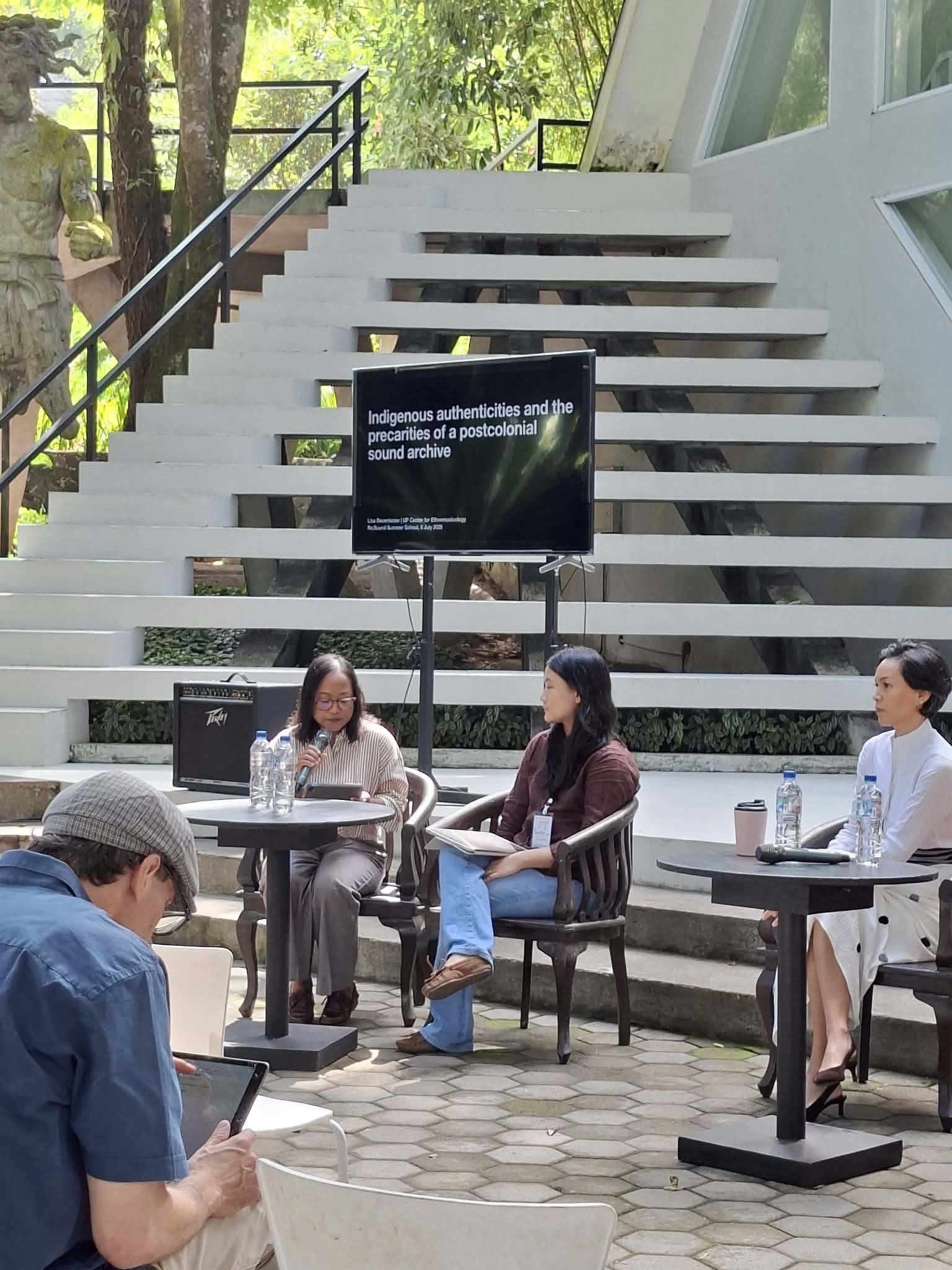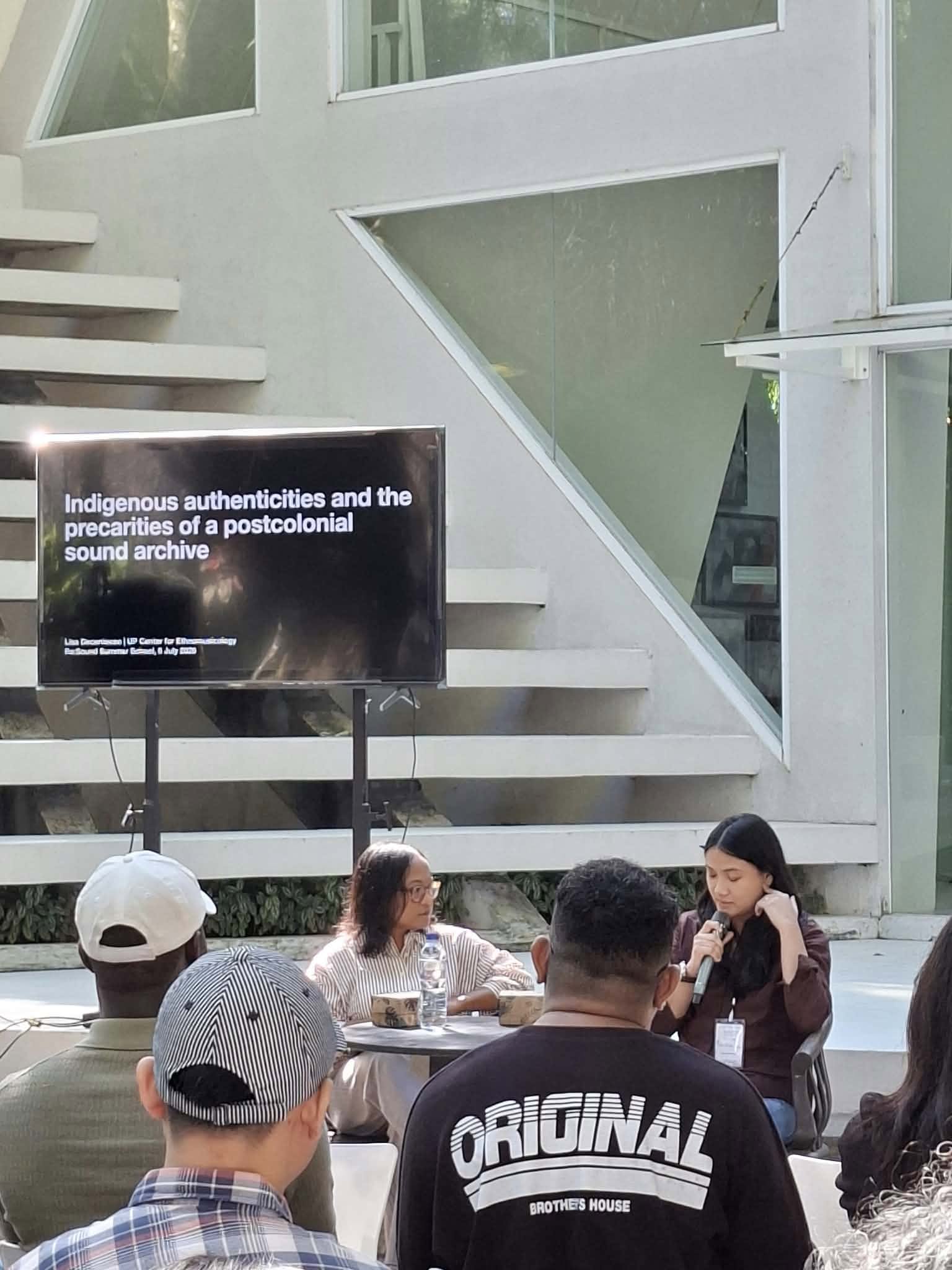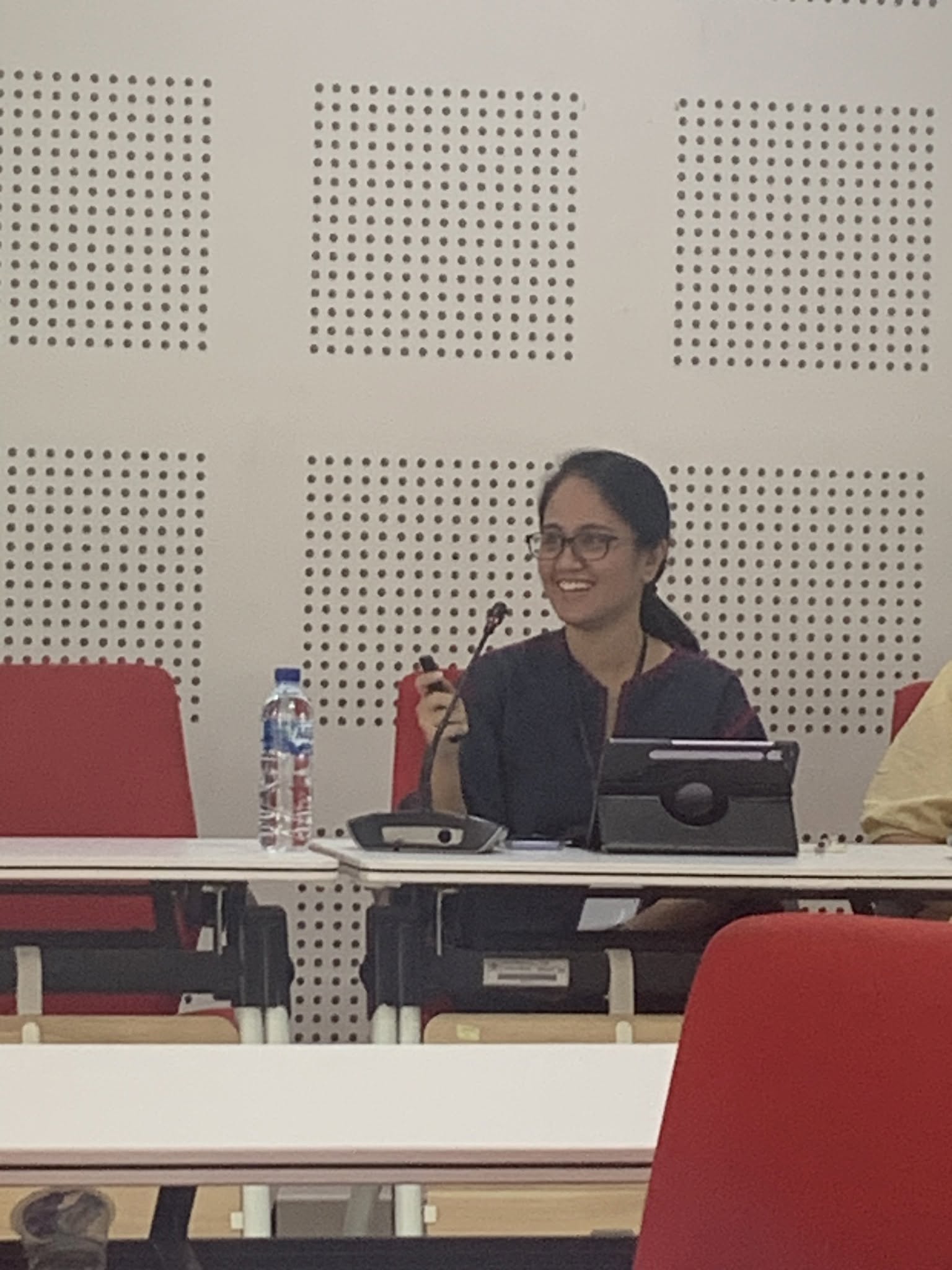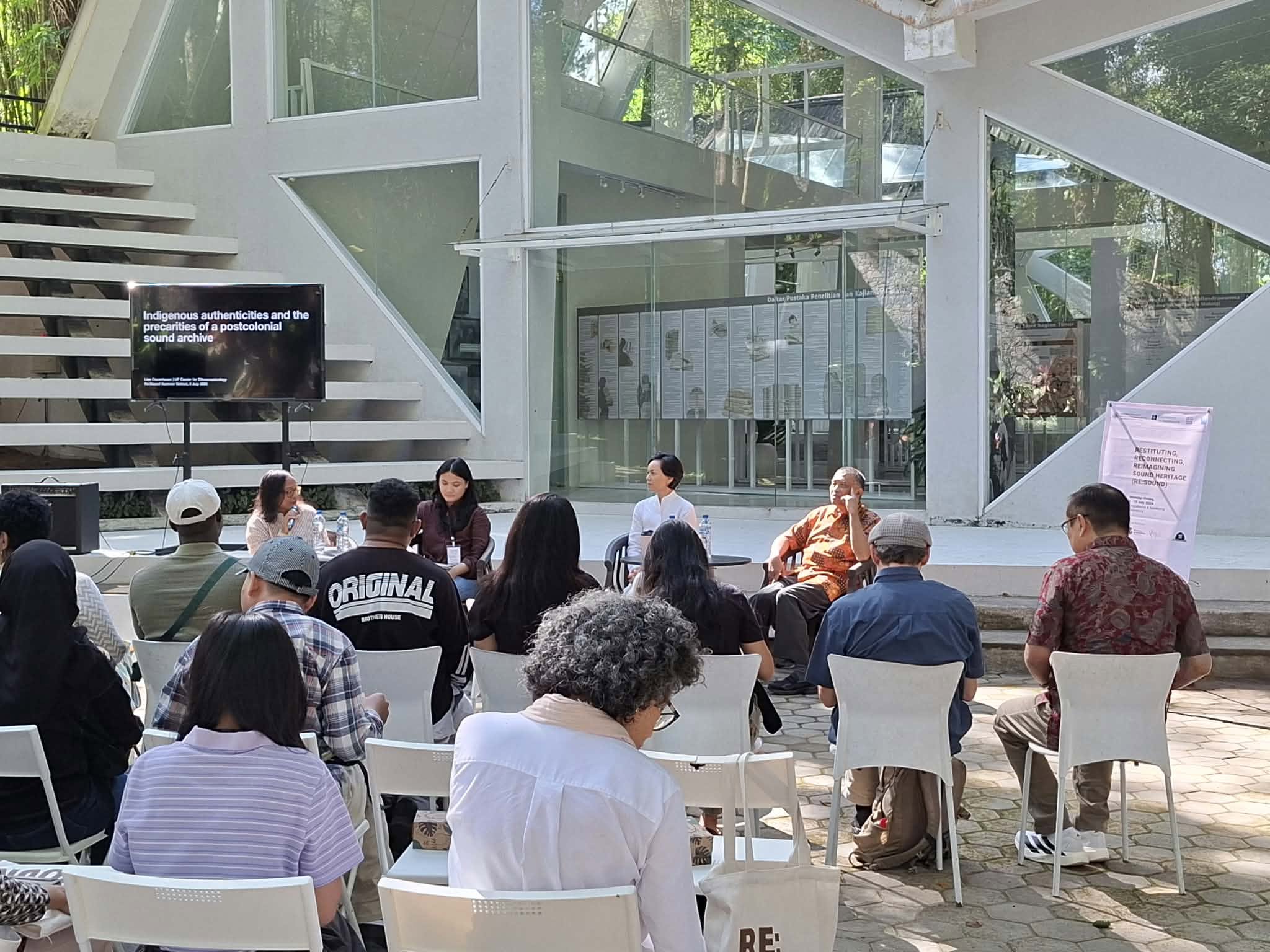
Director Lisa Decenteceo and Collections Manager Roan May Opiso participated as resource speakers in the “Restituting, Reconnecting, Reimagining Sound Heritage (Re:Sound)” Summer School in Yogyakarta and Surakarta, Indonesia.
Speaking alongside artist-scholars and practitioners based in the Netherlands and Indonesia, Roan and Lisa gave talks respectively titled “Navigating concepts of ‘ownership’ between indigenous and national legal frameworks: The case of the UP Center for Ethnomusicology” and “Indigenous authenticities and the precarities of a postcolonial sound archive.” These talks tackled complex issues about archives and restitution in the Philippine context, contributing to a larger conversation about identity, knowledge, and rights in relation to sound and expressive practices in Southeast Asia.
Lisa and Roan also visited Museum Sonobudoyo, Ullen Sentalu Museum, and Lokananta, gaining a local understanding of the role of archives in creating knowledge about sound and sonic expressions.
The UPCE is grateful for the chance to participate in these events, sharing its advocacies while reaching out to people and communities beyond the Philippines.
___
About the Re:Sound Summer School:
The Re:Sound Summer School provides an immersive, collaborative platform for participants from diverse geographical, disciplinary, and institutional backgrounds to critically examine the colonial sound heritage, provenance, ownership, and curatorial agency.
Sound heritage is central to Re:Sound’s effort to rethink and diversify dominant understandings of heritage and curatorial practice. As vibrating air, sound is ephemeral and performative, comparable to dance, performance, and ritual practice rather than fixed material objects. This challenges rigid Eurocentric distinctions between categories such as speech, song, and prayer, which in many cultural contexts are deeply interconnected. Moreover, sound is inherently composite: a synthesis of multiple frequencies, resonances, and voices occurring simultaneously. By focusing on the audible and the sense of hearing, it becomes possible to register multiple perspectives at once – in agreement or opposition, as interacting sonic agents within a landscape, as call-and-response, or even as cacophony. Hearing and listening may be linear in time, like reading or writing, but not in space (Clayton 2001; Turino 2008).
Crucially, Re:Sound prioritises the multiplicity of listener perspectives over the singularity of the sound source. A single sound can signify not only specific objects or events, but also memory, space, place, tradition, intimacy, emotions ranging from revulsion to ecstasy, and even ancestors or spirits. Experiences of the same sound may differ immensely depending on the listener’s cultural background (Turino 2008). Hence, the risk of misinterpreting and mislabelling “sound heritage” is significant, with important consequences for accessibility. Yet these tensions also reflect broader dynamics shaping heritage production more broadly.
The summer school poses a central question: what happens when we begin listening to the archive (Hoffmann & Mnyaka 2014; Yamomo 2018; Birdsall & Tkaczyk 2019; Hoffmann 2023; Hoffmann 2024), rather than only reading it? By extending participation beyond consortium members to (graduate) students, early-career scholars, archivists, curators, artists, and source community representatives, Re:Sound fosters inclusive and dialogical approaches to archival practice across diverse cultural and geographical contexts. Participants will engage with physically and digitally repatriated collections, particularly the Jaap Kunst Collection, as well as sound archives and repositories in Indonesia connected to colonial institutions and histories, such as Sonobudoyo Museum and Lokananta, to critically reimagine the future of sound heritage. Such collective listening opens possibilities for engaging archives both along and against the grain (Stoler 2008), while reflecting on how archival structures, categories, and silences have been historically produced and shaped.
The Re:Sound Summer School is organized by the
the Department of History Faculty of Cultural Sciences Universitas Gadjah Mada in collaboration with
The University of Amsterdam / Universiteit van Amsterdam and Sound and Vision